misc 1.OSINT-3 misc
1.美丽的风景照 gif分帧,按彩虹色排序
jqW2_Dg2C_7HLo8_6yRWh_3CaEK_ZXw8T_98Mz
jqW2
Dg2C
7HLo8
6yRWh
3CaEK
ZXw8T
98Mz
zM89
T8wXZ
KEaC3
hWRy6
8oLH7
C2gD
2Wqj
2.Guess! 猜一下就行了
3.湖心亭看雪 异或+分离zip+添加zip文件头+snow解密
ISCTF{y0U_H4v3_kN0wn_Wh4t_15_Sn0w!!!}
4.小蓝鲨的神秘文件 给了一个这文件ChsPinyinUDL.dat
谁有微软拼音自学习词库的导入导出算法? · Issue #58 · studyzy/imewlconverter
在这找到了转换算法:
1
2
3
4
5
6
7
8
9
10
11
12
13
14
15
16
17
18
19
20
21
22
23
24
25
26
27
28
29
30
31
32
33
34
35
36
37
38
39
40
41
42
43
44
45
46
47
48
49
50
51
52
53
54
import sysimport osimport platformimport pypinyindef str2sysstr (strout ): sysstr = platform.system() if (sysstr =="Windows" ): return strout.encode("gbk" ) else : return strout.encode("utf-8" ) if __name__ == '__main__' : if len (sys.argv)==2 : user_word_file = sys.argv[1 ] else : user_word_file = r"E:\CTF\比赛\isctf\misc\wireshark\ChsPinyinUDL.dat" if not os.path.exists(user_word_file): print ("file:" ,user_word_file,"not exist\n\n" ) print ("use example" ) print ( "user_word_exporter.exe" ) print ( " : paser %USERPROFILE%\AppData\Roaming\Microsoft\InputMethod\Chs\ChsPinyinUDL.dat" ) print ( "user_word_exporter.exe dat_file_name" ) print ( " : paser dat_file_name" ) sys.exit(1 ) fp = open (user_word_file,"rb" ) userword = open ("user_word_microsoft_pinyin.txt" ,"at" ) data = fp.read() cnt = int .from_bytes(data[12 :16 ], byteorder='little' , signed=False ) user_word_base = 0x2400 for i in range (cnt): cur_idx = user_word_base + i * 60 word_len = int .from_bytes(data[cur_idx + 10 :cur_idx + 11 ], byteorder='little' , signed=False ) word = data[cur_idx + 12 : cur_idx + 12 + word_len * 2 ].decode("utf-16" ) pinyin_str = '\t' pinyin_list = pypinyin.pinyin(word, style=pypinyin.NORMAL) for i, py in enumerate (pinyin_list): pinyin_str += py[0 ] if i+1 != word_len: pinyin_str += ' ' one_line = word + pinyin_str + '\t1' print (word + pinyin_str + '\t1' ) userword.write(one_line + "\n" ) fp.close() userword.close()
输出结果如下:
1
2
3
4
5
6
7
8
9
10
11
12
13
14
15
16
17
18
19
20
帮我优化这段代码 bang wo you hua zhe duan dai ma 1 不要乱动我的代码 bu yao luan dong wo de dai ma 1 不要动我原来的代码 bu yao dong wo yuan lai de dai ma 1 出题人说弗莱格在官网 chu ti ren shuo fu lai ge zai guan wang 1 出题人说弗莱格在那里 chu ti ren shuo fu lai ge zai na li 1 官网的新闻里 guan wang de xin wen li 1 弗莱格 fu lai ge 1 还有一些项目合作的机会 hai you yi xie xiang mu he zuo de ji hui 1 福州蓝鲨信息技术有限公司 fu zhou lan sha xin xi ji shu you xian gong si 1 机会是留给有准备的人 ji hui shi liu gei you zhun bei de ren 1 看看官网的新闻吧 kan kan guan wang de xin wen ba 1 你把简历投了再说 ni ba jian li tou le zai shuo 1 你去看看新闻动态呢 ni qu kan kan xin wen dong tai ne 1 你去找辅导员问问 ni qu zhao fu dao yuan wen wen 1 你去蓝鲨官网看看呗 ni qu lan sha guan wang kan kan bei 1 你这个脚本跑不了啊 ni zhe ge jiao ben pao bu liao a 1 他们招实习的 ta men zhao shi xi de 1 这次比赛你参加了吗 zhe ci bi sai ni can jia le ma 1 真的可以去试试 zhen de ke yi qu shi shi 1 在我原来的基础上修改 zai wo yuan lai de ji chu shang xiu gai 1
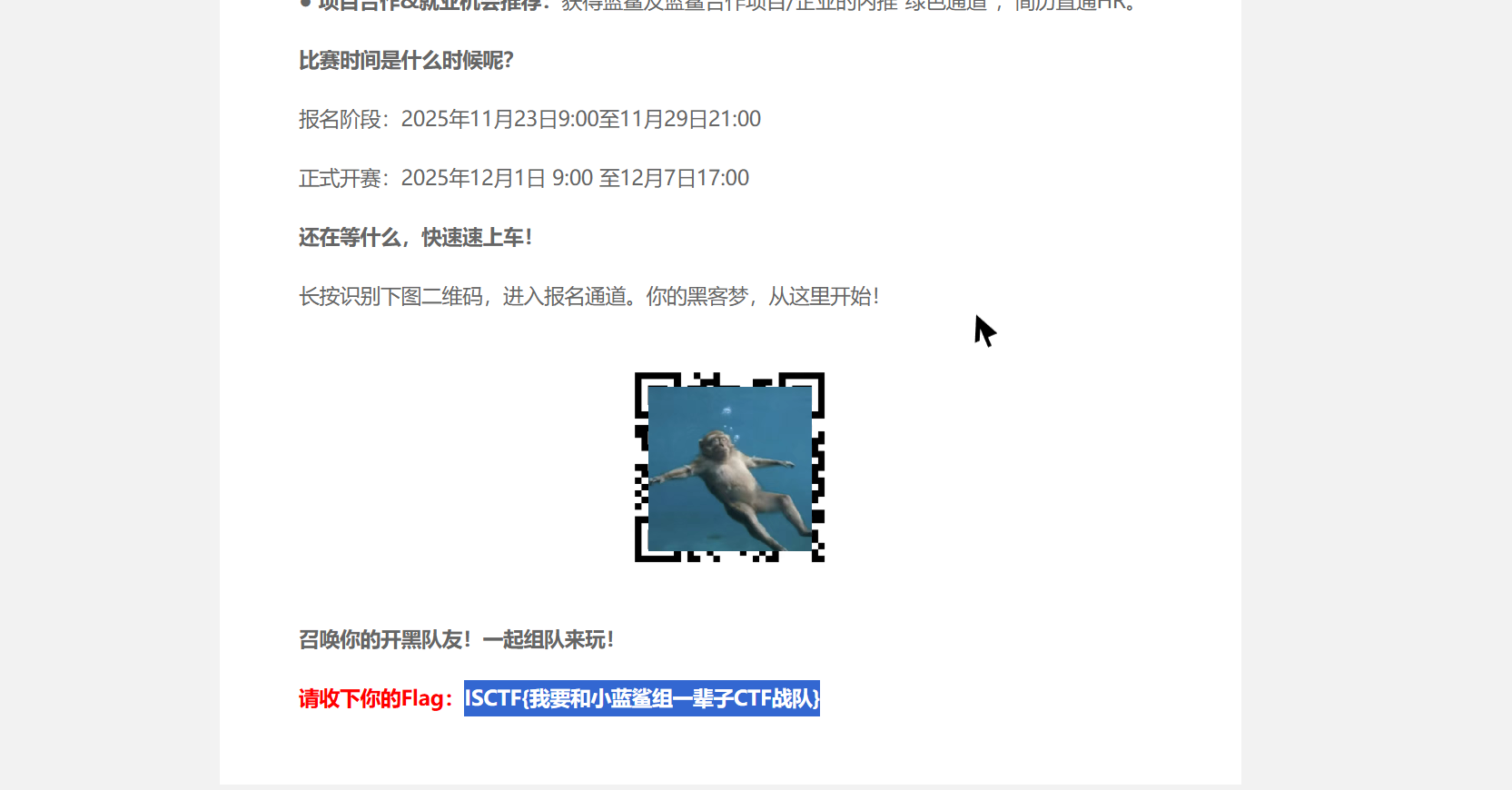
提示到官网新闻动态找
crypto 1 1 2 3 4 5 6 7 8 9 10 11 12 13 14 15 16 17 18 19 from Crypto.Util.number import *p = getPrime(1024 ) q = getPrime(1024 ) N = p*q e = 65537 msg = bytes_to_long(b"ISCTF{dummy_flag}" ) ct1 = pow (msg, e, N) ct2 = pow (msg, p+q, N) print (f"{N = } " )print (f"{ct1 = } " )print (f"{ct2 = } " )""" N = 17630258257080557797062320474423515967705950026415012912087655679315479168903980901728425140787005046038000068414269936806478828260848859753400786557270120330760791255046985114127285672634413513991988895166115794242018674042563788348381567565190146278040811257757119090296478610798393944581870309373529884950663990485525646200034220648901490835962964029936321155200390798215987316069871958913773199197073860062515329879288106446016695204426001393566351524023857332978260894409698596465474214898402707157933326431896629025197964209580991821222557663589475589423032130993456522178540455360695933336455068507071827928617 ct1 = 5961639119243884817956362325106436035547108981120248145301572089585639543543496627985540773185452108709958107818159430835510386993354596106366458898765597405461225798615020342640056386757104855709899089816838805631480329264128349465229327090721088394549641366346516133008681155817222994359616737681983784274513555455340301061302815102944083173679173923728968671113926376296481298323500774419099682647601977970777260084799036306508597807029122276595080580483336115458713338522372181732208078117809553781889555191883178157241590455408910096212697893247529197116309329028589569527960811338838624831855672463438531266455 ct2 = 11792054298654397865983651507912282632831471680334312509918945120797862876661899077559686851237832931501121869814783150387308320349940383857026679141830402807715397332316601439614741315278033853646418275632174160816784618982743834204997402866931295619202826633629690164429512723957241072421663170829944076753483616865208617479794763412611604625495201470161813033934476868949612651276104339747165276204945125001274777134529491152840672010010940034503257315555511274325831684793040209224816879778725612468542758777428888563266233284958660088175139114166433501743740034567850893745466521144371670962121062992082312948789 """
欧拉定理 :
$ msg^{ϕ(N)}≡1\ mod\ N $
而 RSA 中:
$ ϕ(N)=(p−1)(q−1)=N−p−q+1 $
所以我们有:
$ msg^{N−p−q+1}≡1\ mod\ N $
两边同时乘以 msg_p_+q −1,得:
$ msg^{N+1}≡msg^{p+q}\ mod\ N→ ct2≡msg^{N+1}\ mod\ N $
$ ct1≡msg^{e}\ mod\ N $
计算一下发现:
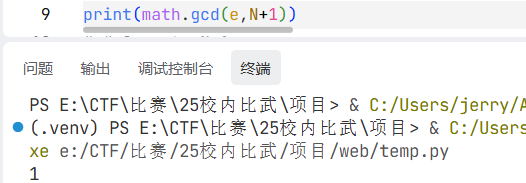
$ gcd(e,N+1)=1 $
这样可以利用gcdext算出
$ ae+b (N+1)=1 $
1
2
from gmpy2g, a, b = gmpy2.gcdext(e, N + 1 )
有:
$ msg^1≡msg^{ea+b (N+1)}≡(msg^e)^a*(msg^{N+1})^b≡(ct1)^a*(ct2)^b\ \ mod\ N $
解题代码:
1
2
3
4
5
6
7
8
9
10
11
12
13
14
15
from Cryptodome.Util.number import long_to_bytesimport gmpy2N = ... ct1 = ... ct2 = ... e = 65537 g, a, b = gmpy2.gcdext(e, N + 1 ) ct1 = pow (ct1, a, N) ct2 = pow (ct2, b, N) m = (ct1 * ct2) % N flag = long_to_bytes(m) print (flag)
pwn 1.ez_fmt 考点:格式化字符串
前置:格式化字符串漏洞利用 参考:格式化字符串漏洞原理及其利用(附带pwn例题讲解)-CSDN博客
有两个比较好玩的输出:一个是%n,一个格式%\d$s
很久没写c了,有点手生
1 2 3 4 5 6 7 8 9 10 11 12 13 14 15 16 17 18 #include <stdio.h> int main () { int cnt; printf ("he%nllo\n" , &cnt); printf ("%d\n" ,cnt); printf ("hello%n\n" , &cnt); printf ("%d" ,cnt); return 0 ; }
1 2 3 4 5 6 7 8 9 10 11 #include <stdio.h> int main () { char a[] = "aaaa" ; char b[] = "bbbb" ; char c[] = "cccc" ; char d[] = "dddd" ; printf ("%3$s %2$s %1$s" , a, b, c); return 0 ; }